NITROCELLULOSE: A KEY MATERIAL IN THE COATING INDUSTRY, BUT REQUIRES EXTRA CARE IN HANDLING
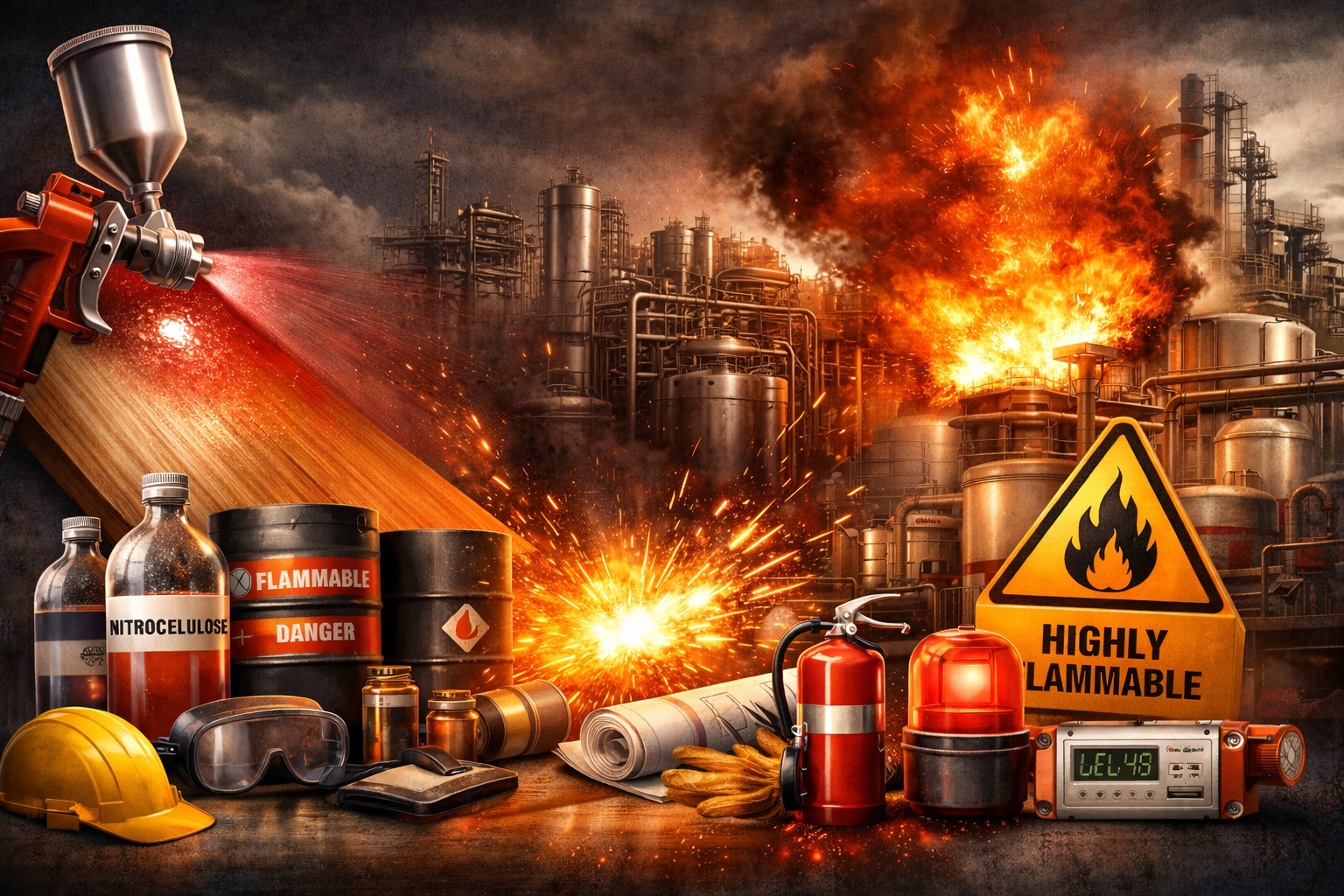
In the paint and coatings industry, one material is widely known for its ability to produce fast-drying and glossy finishes—nitrocellulose (NC). This material has long been used in various applications, especially in wood coatings, automotive paints, printing inks, and lacquer finishing.
However, behind its advantages, nitrocellulose also has characteristics that require serious attention—particularly related to fire risk.
What is Nitrocellulose?
Nitrocellulose is a derivative of cellulose (natural fibers from wood or cotton) that has undergone a nitration process. The result is a material that:
✔ Dries quickly
✔ Provides a smooth and glossy finish
✔ Easy to sand
✔ Suitable for wood and metal finishing
Due to its rapid evaporation and excellent film-forming properties, nitrocellulose is highly popular in the furniture and decorative coating industries.
Why is Nitrocellulose Highly Flammable?
This is the critical aspect to be aware of.
Nitrocellulose is classified as a highly flammable material because it:
- Contains nitrate groups in its chemical structure
- Reacts rapidly to heat and sparks
- Can ignite without a significant ignition source
- Generates high heat when burning
Under dry and unstable conditions, nitrocellulose can even undergo auto-ignition.
The risk increases when:
- Stored at high temperatures
- Exposed to static electricity
- Accumulated as dust or dry residues
- Stored in poorly ventilated areas
Risks in the Paint Industry
In paint manufacturing facilities, fire risks typically arise in:
🔸 Raw material storage areas
🔸 Mixing areas
🔸 Drying areas
🔸 Semi-finished product warehouses
The solvent vapors associated with nitrocellulose are also highly flammable. Even a small spark combined with solvent vapor can trigger an explosion.
Therefore, safety standards in the coating industry are typically very strict for NC-based products.
How to Reduce Fire Risk
Common safety practices in the industry include:
✔ Storing in wet conditions (wet storage) or preferably in solution form using strong solvents such as MIBK, Xylene, Butyl Acetate, and alcohols
✔ Proper ventilation systems
✔ Grounding and bonding to prevent static electricity
✔ Use of anti-spark and explosion-proof equipment
✔ Automatic fire detection and suppression systems
✔ Regular employee training
In addition, strict SOPs and periodic safety audits are essential.
Nitrocellulose in the Coatings Industry: Risk & Control Perspective for QHSE Managers
Nitrocellulose (NC) is widely used as a film-forming agent in lacquers, wood coatings, and industrial inks due to its fast-drying properties and smooth finish. However, from a Quality, Health, Safety, and Environment (QHSE) perspective, it is a high-risk material requiring systematic control.
1. Hazard Profile
Technically, nitrocellulose has the following characteristics:
- Highly flammable solid
- Sensitive to heat, friction, and sparks
- Can undergo exothermic decomposition
- Produces toxic gases (NOx) when burned
Risks increase under:
- Low moisture content (dry NC is more sensitive)
- High storage temperatures
- Accumulation of NC dust
- Poor ventilation
- Static electricity exposure
In solvent-based systems, additional hazards include:
- Low Lower Explosive Limit (LEL) of solvent vapors
- Potential formation of explosive atmospheres (ATEX conditions)
2. High-Risk Areas in Paint Plants
QHSE should focus on:
🔹 Raw material warehouse
🔹 Mixing & dispersion areas
🔹 Solvent handling stations
🔹 Filling & packaging areas
🔹 Waste storage areas (dry NC residues are highly hazardous)
Hazardous zones (Zone 1 / Zone 2) must be regularly audited.
3. Engineering Controls
Recommended controls include:
✔ Storage
- Keep NC in wet condition (with alcohol/water)
- Avoid heat sources and direct sunlight
- Use well-ventilated storage areas
✔ Static Electricity Prevention
- Grounding & bonding across all transfer systems
- Use conductive hoses and pumps
- Ensure grounding resistance < 10 ohms
✔ Equipment
- Use explosion-proof motors and panels
- Use non-sparking tools
- Install flame and gas detectors
✔ Ventilation
- Maintain solvent vapor concentration < 25% LEL
- Use monitored exhaust systems
4. Administrative Controls
🔸 SOPs for handling flammable materials
🔸 Permit to Work (Hot Work Permit required)
🔸 Lock Out Tag Out (LOTO) procedures
🔸 Emergency Response Team (ERT) training
🔸 Fire drills at least 1–2 times per year
Safety Data Sheets (SDS) must be accessible and understood by operators.
5. Fire Protection Strategy
Facilities using nitrocellulose should include:
✔ Fire hydrant systems
✔ Foam suppression systems
✔ Automatic sprinklers
✔ Firewalls between production areas
✔ Clear emergency exits
Fire extinguishing media must match the fire class (Class B for solvents).
Effective nitrocellulose risk management is not only about compliance, but also a key part of business sustainability.
Recommendations for QHSE Managers
- Conduct HAZOP or specific risk assessments for NC areas
- Review zoning every 2–3 years
- Periodically audit grounding systems
- Evaluate substitution of high-risk resins
- Integrate fire risk into operational KPIs
Conclusion
Nitrocellulose is a key material in the coatings industry, offering superior finishing quality and fast drying time. However, its highly flammable nature requires professional handling and strict safety systems.
In modern industry, success is not only about product quality, but also about safety and risk management.
Because in the chemical industry, safety is the foundation of sustainability.
Closing
Nitrocellulose remains an essential material in the coatings industry. However, without strong risk management, fire hazards can significantly impact safety, assets, and company reputation.
The role of QHSE is not only to prevent incidents but to ensure safe, efficient, and sustainable operations.
Because in the chemical industry, zero accidents is not a slogan—it is a system that must be built.